9 Best Chemical Sunscreens That Won’t Leave a White Cast
 Collage: Paula Balondo; Source images: Courtesy of brandsSave this storySave this story
The best chemical sunscreens have come a long way from the greasy, sting-your-eyes formulas many of us grew up with. Today's versions are airy, elegant, and often so comfortable to wear that you'll forget you even have SPF on—a major win, considering sunscreen is one of the most important steps in any skin-care routine. “Unlike mineral sunscreens, which sit on top of the skin, chemical sunscreens use organic UV filters that absorb UV radiation and convert it into heat, which is then released from the skin,” says Pearl Rimtepathip, MD, a board-certified dermatologist based in Atlanta. “These formulas tend to feel especially lightweight and are well-suited for everyday wear.”
Another perk? Because chemical filters are absorbed into the skin, they “generally blend in seamlessly without leaving behind a white cast,” she says. Whether you prefer a featherlight fluid, a hydrating serum, or a makeup-gripping primer, there's a chemical sunscreen for nearly every skin type, concern, and personal preference. Because at the end of the day—and whether you choose a chemical or mineral formula—“the best kind of sunscreen is the one you will use and apply the most,” says Dr. Rimtepathip.
Our Top Chemical Sunscreens
- Best Overall: Peach & Lily Beam Blocker Invisible Sunscreen SPF 30, $34
- Best Tinted: EltaMD UV Clear Tinted SPF 46, $47
- Best Drugstore: La Roche-Posay Anthelios UVAir Serum Sunscreen SPF 50, $40
- Best for Dull Skin: Isdin Fusion Water Magic SPF 40, $38
Frequently Asked QuestionsLargeChevron
- What is a chemical sunscreen?
- What's the difference between chemical and mineral sunscreen?
- Are chemical sunscreens safe?
- Are chemical sunscreens "bad" for sensitive skin?
- Meet the experts
- How we test and review products
- Our staff and testers
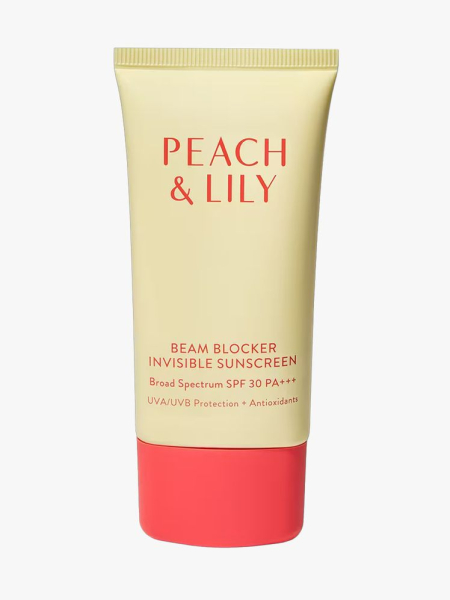
Best Overall: Peach & Lily Beam Blocker Invisible Sunscreen SPF 30
 Save to wishlist
Peach & Lily
Beam Blocker Invisible Sunscreen SPF 30
Ulta Beauty
Allure senior beauty editor Jesa Marie Calaor applying the Peach & Lily Beam Blocker Invisible Sunscreen
Jesa Marie Calaor
Why it's worth it: Our testers dutifully submitted before-and-after photos for Peach & Lily’s Beam Blocker Invisible Sunscreen SPF 30—but you'd be hard-pressed to spot any difference, because this formula is truly invisible. The lightweight lotion melts into skin without a hint of white cast and feels more like a silky moisturizer than a sunscreen. In addition to broad-spectrum protection, it's packed with soothing ingredients like ectoin, Centella asiatica, and bisabolol to keep redness and irritation at bay, while antioxidants like green tea and ferulic acid defend against environmental stressors. Niacinamide brightens, ceramides and panthenol support the skin barrier, and the fast-absorbing texture creates a perfect canvas under makeup, so foundation glides on smoothly without pilling or patchiness.
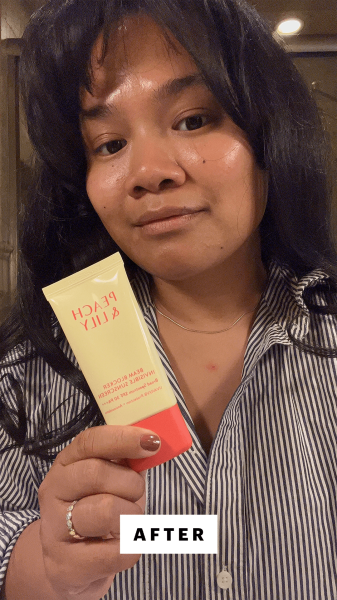
Calaor after applying the Peach & Lily Beam Blocker Invisible Sunscreen
Jesa Marie Calaor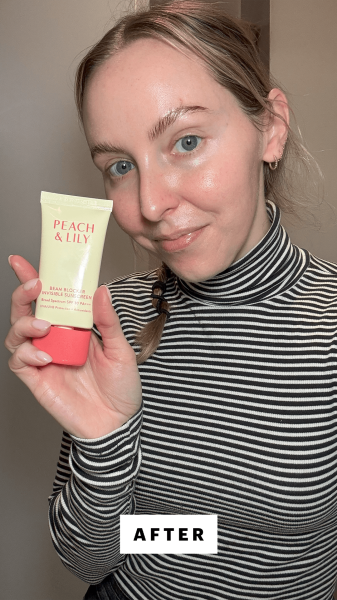
Allure beauty director Kinonen after applying the Peach & Lily Beam Blocker Invisible Sunscreen
Sarah Kinonen
Tester feedback from senior beauty editor Jesa Marie Calaor
LargeChevron
“My skin is dehydrated year-round, so all of my face products need to be hydrating. This one delivers, creating that satisfying "squish" as I massage it in. It feels like a moisturizer and absorbs within seconds of application. It acts as a fantastic base for makeup—smoothing dry patches and never pilling under my skin tints or liquid foundations. I use it every day on my face, neck, and on and behind my ears. I even gave it to my dad to try, and he said the formula feels like a regular facial moisturizer, which is a big plus for someone hesitant to use sunscreen daily.” —Jesa Marie Calaor, senior beauty editor
Tester feedback from beauty director Sarah Kinonen
LargeChevron
“I use this sunscreen every day! I was obsessed after the first slathering of this stuff. It's lightweight, easily blendable, and doesn't irritate my eyes, which is a feat for a chemical sunscreen. (There's nothing worse than being mid-workout, trying to blink out the sting from the SPF sweat.) It also layers well under… everything. Foundation? Yep. Copious amount of liquid blush? Also yes. It never pills and isn't greasy or sticky, and most importantly, it doesn't irritate my easily inflamed skin. A true win!” —Sarah Kinonen, beauty director
More to know
LargeChevron
- Sunscreen filter: 3% avobenzone, 7% homosalate, 5% octisalate
- Key ingredients: ceramides, panthenol, hyaluronic acid, ectoin, bisabolol, Centella asiatica, green tea, ferulic acid
- Tinted: no
- Water-resistant: not disclosed
- Fragrance-free: yes
Best Drugstore: La Roche Posay Anthelios UVAir Serum Sunscreen SPF 50
 Save to wishlist
La Roche-Posay
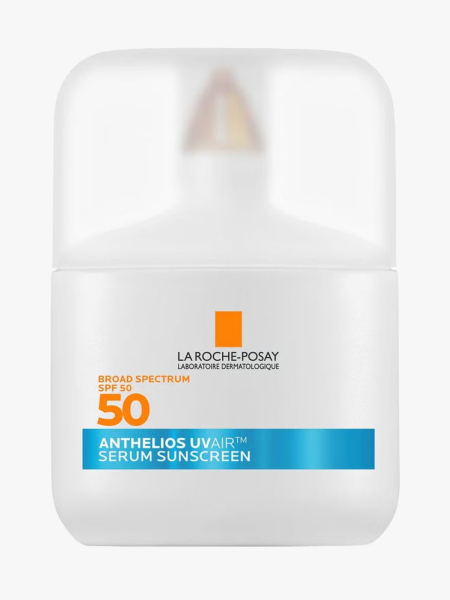
Anthelios UVAir Serum Sunscreen SPF 50
Amazon
Dermstore
Ulta Beauty
Allure contributing commerce editor Deanna Pai applying the La Roche Posay Anthelios UVAir SPF 50 Serum Sunscreen
Deanna Pai
Why it's worth it: If you usually find yourself "forgetting" sunscreen because it feels greasy or heavy, La Roche-Posay's Anthelios UVAir SPF 50 Serum Sunscreen may finally win you over. The featherlight formula lives up to its "air" name, disappearing into skin with an invisible finish that feels more like a silky serum thanks to glycerin and hyaluronic acid that provide long-lasting hydration. The brand's proprietary Cell-Ox B3 Shield technology combines UV filters with antioxidants like vitamin E, senna alata leaf extract, and niacinamide to defend skin against not only sun damage, but also free radicals and pollution that can contribute to premature aging. It also stands up to high heat, humidity, and pollution, a.k.a. the unholy trinity of summer skin woes, and “layers nicely under makeup, so it’s an excellent option for daily use,” says Dr. Kil.
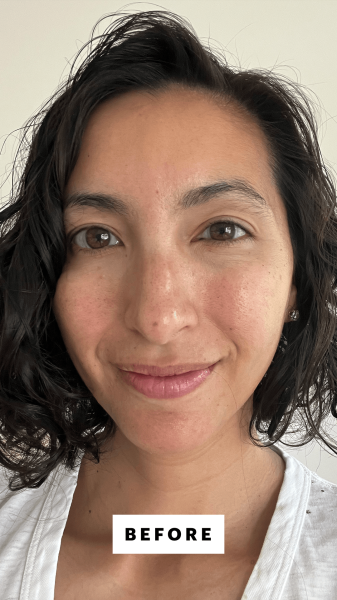
Pai before applying the La Roche Posay Anthelios UVAir SPF 50 Serum Sunscreen
Deanna Pai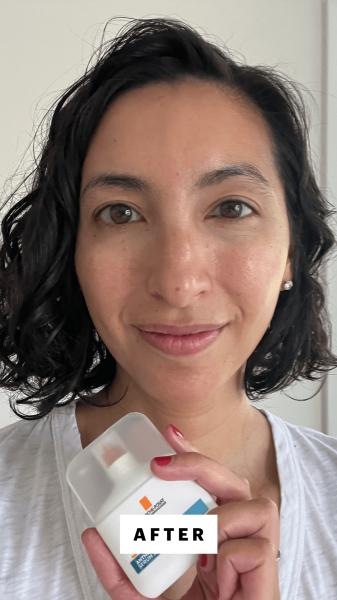
Pai after applying the La Roche Posay Anthelios UVAir SPF 50 Serum Sunscreen
Deanna Pai
Tester feedback from contributing commerce editor Deanna Pai
LargeChevron
“In the summer, sunscreen gets complicated: I sweat during my workout, shower, and then continue to sweat. That's why this latest La Roche-Posay sunscreen has been a godsend in my routine: It blends in quickly and feels virtually undetectable. It's been especially helpful for humid days when I want to re-up, since I can layer it on ahead of a walk or park hang without my skin looking or feeling greasy.” —Deanna Pai, contributing commerce editor
More to know
LargeChevron
- Sunscreen filter: 3% avobenzone, 7% homosalate, 5% octisalate, 7% octocrylene
- Key ingredients: glycerin, niacinamide, hyaluronic acid, vitamin E, senna alata leaf
- Tinted: no
- Water-resistant: not disclosed
- Fragrance-free: yes
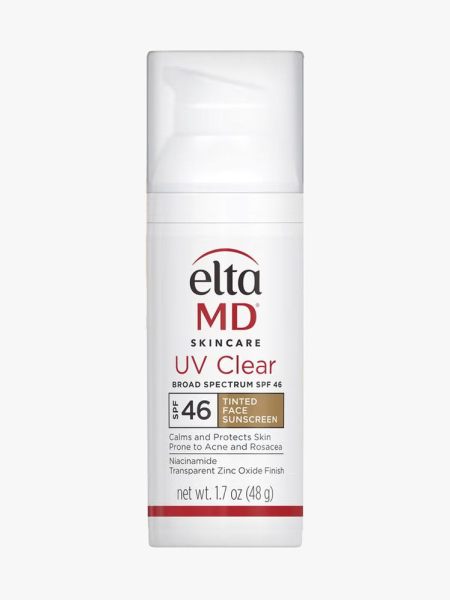
Best Tinted: EltaMD UV Clear Tinted SPF 46
 Save to wishlist
EltaMD
UV Clear Tinted SPF 46
EltaMD
Amazon
Dermstore
Allure contributor Jailynn Taylor applying the EltaMD UV Clear Tinted SPF 46
Jailynn Taylor
Why it's worth it: When you want to even out your complexion but don't feel like wearing a full face of makeup, EltaMD’s UV Clear Tinted SPF 46 strikes the perfect balance. “EltaMD was one of the earliest brands to incorporate iron oxides in its tinted sunscreen formulation,” says Erin Kil, MD, a board-certified dermatologist based in New York City. “Iron oxides, which are found in tinted sunscreens, help block visible light, a known trigger for melasma, particularly in medium to deeper skin tones," adds Asmi Berry, DO, is a board-certified medical and cosmetic dermatologist based in Glendale, California. Plus, the sheer tint subtly blurs redness and discoloration without looking heavy or masking your skin. "The natural-looking tint, combined with niacinamide, makes this a great option for those prone to hyperpigmentation, helping to even out skin tone," says Dr. Rimtepathip.
Technically, it's a hybrid sunscreen, pairing 9% zinc oxide with 7.5% octinoxate—a combination that can be especially appealing for those who want the gentle, sensitive skin-friendly benefits of mineral SPF with a lighter feel and less risk of a white cast. The formula also features hyaluronic acid to boost hydration, vitamin E to defend against free radicals, and lactic acid for gentle skin-smoothing benefits. Since “it's fragrance-free, dye-free, and oil-free, it's also well-suited for acne-prone skin,” says Dr. Rimtepathip.
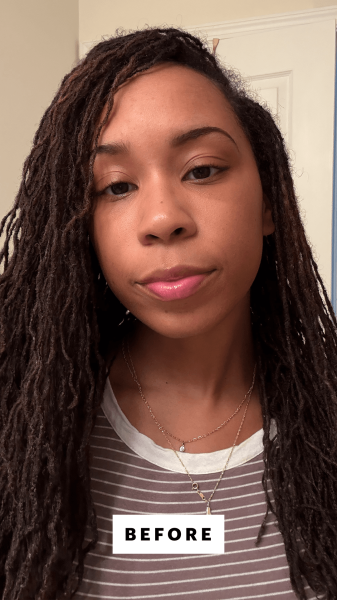
Taylor before applying the EltaMD UV Clear Tinted SPF 46
Jailynn Taylor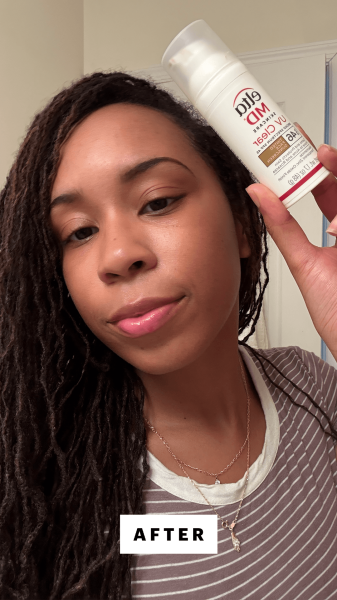
Taylor after applying the EltaMD UV Clear Tinted SPF 46
Jailynn Taylor
Tester feedback from contributor Jailynn Taylor
LargeChevron
"EltaMD’s Tinted Sunscreen has become a staple in my morning routine. It’s more on the sheer side, so I still reach for concealer when I need to cover deeper discoloration, but the lightweight formula is perfect for evening out my complexion on days when I just need to run errands without doing a full face. I love that it doesn’t transfer onto my clothes or hands (I chronically touch my face), and best of all, it hasn’t clogged my pores or caused any breakouts, like other sunscreens I’ve tested.” —Jailynn Taylor, contributor
More to know
LargeChevron
- Sunscreen filter: 9% zinc oxide, 7.5% octinoxate
- Key ingredients: 5% niacinamide, hyaluronic acid, vitamin E, lactic acid
- Tinted: yes
- Shades: 1
- Water-resistant: not disclosed
- Fragrance-free: yes
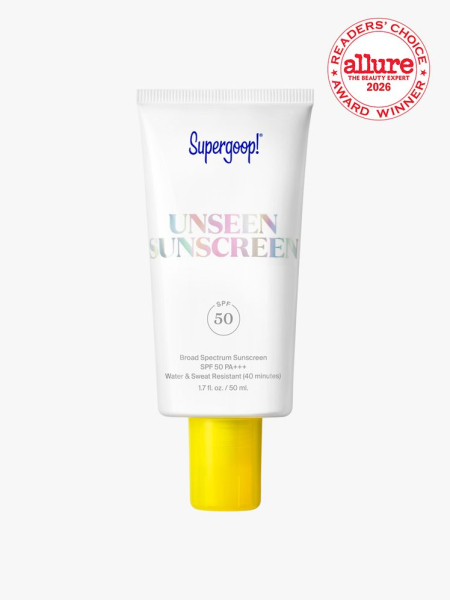
Best for Sensitive Skin: Supergoop Unseen Sunscreen SPF 50
 Save to wishlist
Supergoop
Unseen Sunscreen SPF 50
Amazon
Nordstrom
Ulta Beauty
Allure contributing commerce writer Christa Joanna Lee
Christa Joanna Lee
Why it's worth it: Chemical sunscreen can be a tough sell for people with sensitive skin, for whom certain filters (like oxybenzone) can be irritating. Supergoop’s Unseen Sunscreen SPF 50 is a fragrance-free formula that’s free of both, making it a gentler option for those who typically struggle with chemical SPF. The invisible formula melts into skin and “has a similar texture to a velvety makeup primer, smoothing over pores and helping complexion products layer with ease,” says Dr. Rimtepathip. There’s also soothing chamomile-derived bisabolol and licorice root to calm redness and support a more even-looking complexion, while meadowfoam seed oil reinforces the skin barrier by locking in moisture. Just keep in mind that because the formula goes on completely clear with a matte finish, it can be easy to miss spots—so don't be shy about applying generously.
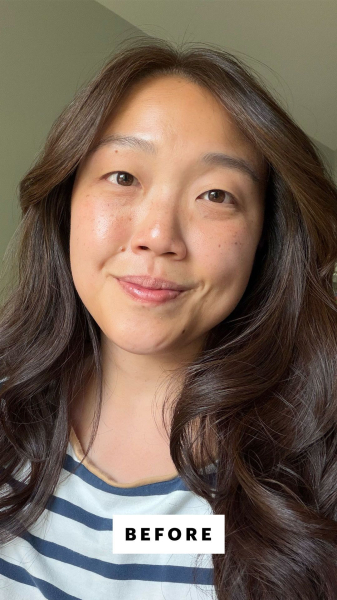
Lee before applying the Supergoop Unseen Sunscreen SPF 50
Christa Joanna Lee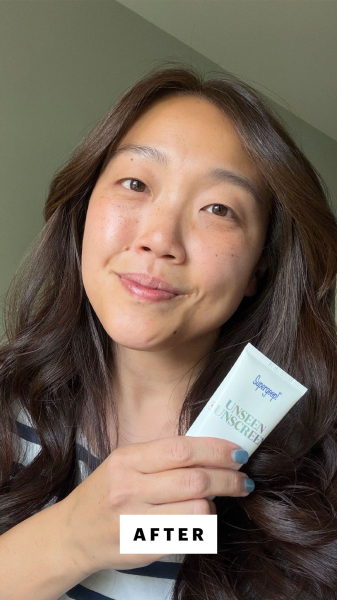
Lee after applying the Supergoop Unseen Sunscreen SPF 50
Christa Joanna Lee
Tester feedback from contributing commerce writer Christa Joanna Lee
LargeChevron
"After 13 years together, my husband has finally gotten into the habit of wearing sunscreen every day—and the one he steals from me most often is Supergoop Unseen Sunscreen SPF 50. He has oily skin, I have dry/sensitive skin, yet the primer-like, semi-matte formula works great for both of us. It glides on completely clear, feels weightless, and has a cushiony gel texture that dries down to a soft, almost powder-like finish. The only slight drawback is that because it's totally invisible, it can be hard to tell whether you've covered every inch of your face. But as long as I stick to the two-finger rule for application, I trust the process." —Lee, contributing commerce writer
More to know
LargeChevron
- Sunscreen filter: 3% avobenzone, 7% homosalate, 5% octisalate, 9% octocrylene
- Key ingredients: bisabolol, licorice root, meadowfoam seed oil
- Tinted: no
- Water-resistant: 40 minutes
- Fragrance-free: yes
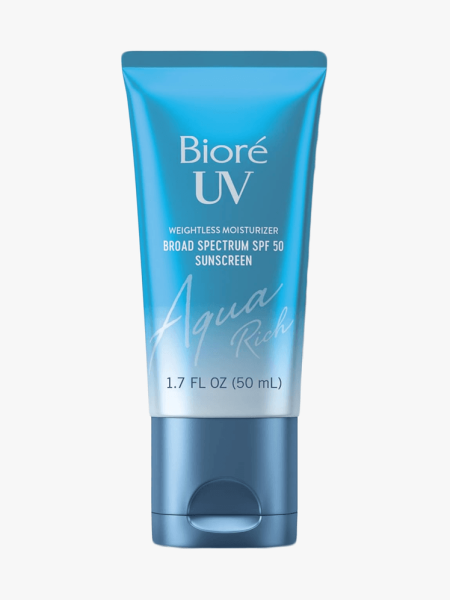
Best for Oily Skin: Bioré UV Aqua Rich Weightless Moisturizer SPF 50
 Save to wishlist
Bioré
UV Aqua Rich Weightless Moisturizer SPF 50
Amazon
Ulta Beauty
Why it's worth it: If you have oily skin, chances are you've had at least one sunscreen leave you looking shinier than you bargained for. Bioré’s UV Aqua Rich Weightless Moisturizer SPF 50—a 2024 Allure Best of Beauty—feels practically weightless on skin, absorbing quickly without clogging pores or leaving behind a greasy residue. Yet despite its barely-there texture, it still delivers a big dose of hydration thanks to “glycerin and sodium hyaluronate, which draw water into the skin without weighing it down,” says Geeta Yadav, MD, board-certified dermatologist based in Toronto, Canada. The only caveat: It contains added fragrance, so those with sensitive skin may want to patch-test first.
Allure managing editor Alessandra Foresto applying the Bioré UV Aqua Rich Weightless Moisturizer SPF 50
Alessandra Foresto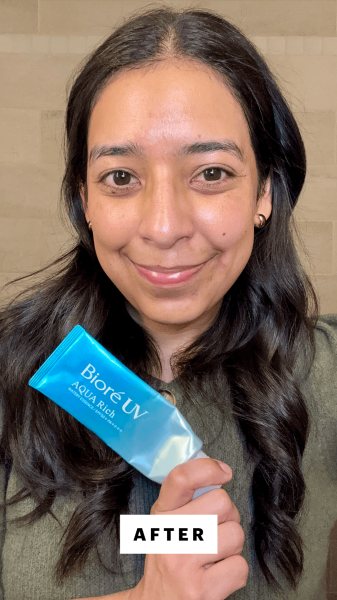
Foresto after applying the Bioré UV Aqua Rich Weightless Moisturizer SPF 50
Alessandra Foresto
Tester feedback from managing editor Alessandra Foresto
LargeChevron
“I truly use this sunscreen up to the last drop (I'm due for a restock!). That's because the rumors (and social videos) are true; this sunscreen is superior. Its gel-like, watery texture gives your skin a glowy finish, but doesn't feel greasy. The SPF doesn't travel into your eyes or make them sting. And it doesn't leave a white cast behind on my brown skin. The formula is so lightweight, but it contains hyaluronic acid, so it feels super moisturizing and gives you a nice dewy look. My husband is also a huge fan of this SPF because it spreads nicely over his beard without leaving behind flakes or peeling. He uses it on his body too and finds it doesn't give white T-shirts that yellowy tint that some sunscreens leave behind.” —Alessandra Foresto, managing editor
More to know
LargeChevron
- Sunscreen filter: 3% avobenzone, 10% homosalate, 5% octisalate, 5% octocrylene
- Key ingredients: glycerin, sodium hyaluronate
- Tinted: no
- Water-resistant: not disclosed
- Fragrance-free: no
Best for Dry Skin: Belif Aqua Bomb Sunscreen SPF 45
 Save to wishlist
Belif
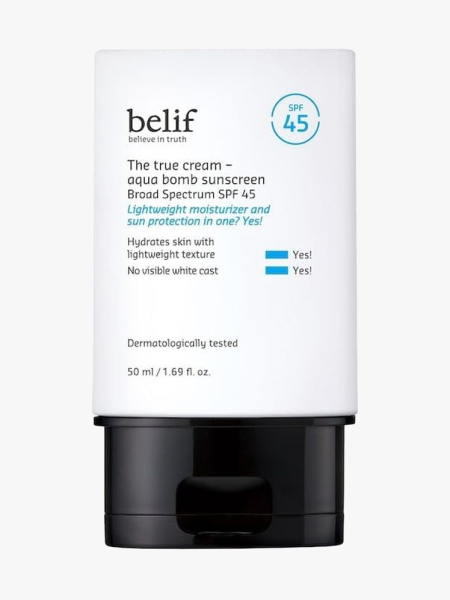
Aqua Bomb SPF 45 Hydrating Niacinamide Sunscreen PA++++
Amazon
Sephora
Lee applying the Belif Aqua Bomb Sunscreen SPF 45
Christa Joanna Lee
Why it's worth it: If you're already devoted to Belif's editor-favorite The True Cream Aqua Bomb Moisturizer, Aqua Bomb Sunscreen SPF 45 delivers a similar burst of hydration—with the added benefit of daily sun protection. It retains many of the hallmarks that made the original viral, including glycerin, panthenol, niacinamide, and Belif's signature botanical blend of oat seed, calendula, and other soothing herbs.
But compared to the moisturizer, this sunscreen relies less on richer conditioning ingredients like shea butter and squalane and more on lightweight silicones and texture-enhancing polymers, giving it a smoother, silkier feel that wears more like a lotion-primer hybrid than a gel-cream. It glides effortlessly across skin, layers nicely under makeup, and leaves behind a smooth, even finish. “It's refreshing and quick-absorbing while still leaving skin feeling plumped and comfortable,” says Jane Yoo, MD, a dual board-certified dermatologist and Mohs surgeon based in New York City.

Lee before applying the Belif Aqua Bomb Sunscreen SPF 45
Christa Joanna Lee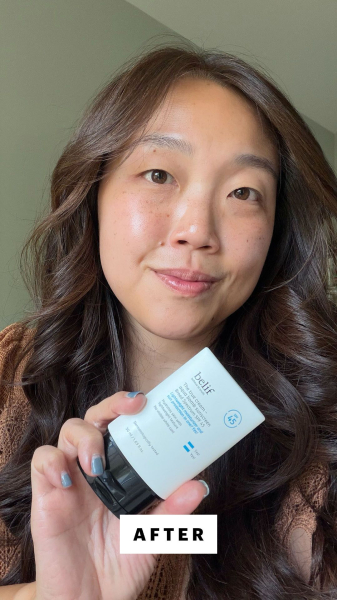
Lee after applying the Belif Aqua Bomb Sunscreen SPF 45
Christa Joanna Lee
Tester feedback from Lee
LargeChevron
“I have yet to try the famous Belif Aqua Bomb Moisturizer (I know—sacrilege), but after practically emptying my tube of Aqua Bomb Sunscreen SPF 45 in just a couple of weeks, I'm not sure I need to. This sunscreen checks every box on my wish list: It's incredibly lightweight and moisturizing, has a cream texture yet absorbs with the speed and ease of a gel, and leaves behind absolutely zero white cast. The results may not be dramatic in a before-and-after photo, but the difference is immediately noticeable once it's on your skin. I couldn't ask for much more from a sunscreen.” —Christa Joanna Lee, contributing commerce writer
More to know
LargeChevron
- Sunscreen filter: 2.7% avobenzone, 9% homosalate, 4.5% octisalate, 9% octocrylene
- Key ingredients: glycerin, panthenol, niacinamide, oat seed, calendula
- Tinted: no
- Water-resistant: not disclosed
- Fragrance-free: yes
Best for Combo Skin: Manyo Air Light Moisturizing Sunscreen Cream SPF 50
 Save to wishlist
Manyo
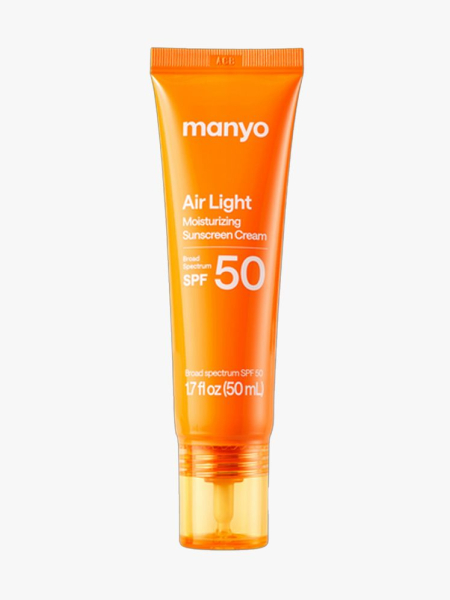
Air Light Moisturizing Sunscreen Cream SPF 50
Amazon
Ulta Beauty
Allure commerce editor Sarah Han applying the Manyo Air Light Moisturizing Sunscreen Cream SPF 50
Sarah Han
Why it’s worth it: As people with combination skin know all too well, finding a sunscreen can be tricky: Too rich, and your T-zone turns slick; too lightweight, and your cheeks are craving moisture. Manyo’s Air Light Moisturizing Sunscreen Cream SPF 50 walks that fine line, thanks in part to ensulizole, a lesser-known but FDA-approved UV filter prized for its water-solubility and lightweight feel.
Yet it still delivers plenty of hydration via nano-hyaluronic acid and hydrolyzed hyaluronic acid. Unlike traditional hyaluronic acid, which primarily hydrates the skin's surface, these smaller forms can penetrate more deeply for longer-lasting hydration and a plumper feel. If you’re dealing with uneven skin tone, the formula also helps address discoloration with tranexamic acid, niacinamide, and vitamin E, which work together to fade existing dark spots and defend against future pigmentation.
Tester feedback from commerce editor Sarah Han
LargeChevron
“Korean sunscreens are so good that it's honestly hard for one to stand out from the rest. (I try a lot of them, ok?) However, thanks to the US banning sales of non-FDA-approved sunscreen filters, our options have gotten a bit more interesting. I've been testing this Manyo Air Light SPF for a few months, thanks to Best of Beauty testing, and have been smitten with it ever since. It has that serum-y texture I love in my sunscreens that melts into my skin super quickly—because I can't be bothered to rub in sunscreen for 15 seconds when there are faster options! It's super breathable and layers beautifully without a trace of pilling.” —Sarah Han, commerce editor
More to know
LargeChevron
- Sunscreen filter: 2.5% ensulizole, 5% homosalate, 4.5% octisalate, 5% octocrylene
- Key ingredients: tranexamic acid, hyaluronic acid, niacinamide
- Tinted: no
- Water-resistant: not disclosed
- Fragrance-free: yes
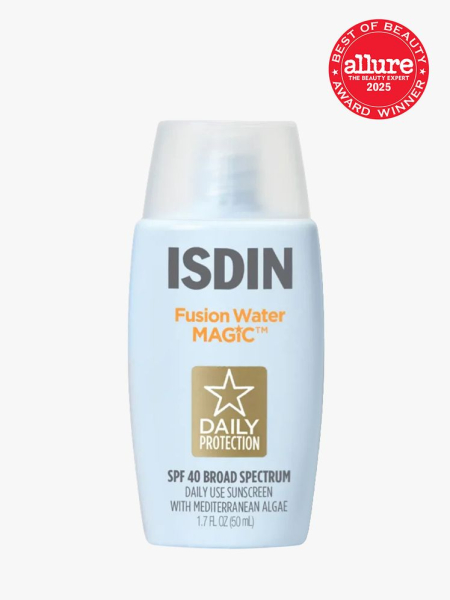
Best for Dull Skin: Isdin Fusion Water Magic SPF 40
 Save to wishlist
Isdin
Fusion Water Magic SPF 40
Amazon
Sephora
Allure associate beauty editor Annie Blay-Tettey applying the Isdin Fusion Water Magic SPF 40
Annie Blay-Tettey
Why it’s worth it: We'd never promise magic in a bottle, but Isdin's Fusion Water Magic SPF 40 comes pretty close with its remarkably lightweight, fluid texture. The 2025 Best of Beauty Award winner glides onto skin and disappears in seconds, leaving no heaviness or greasy residue behind. The formula also gives dull skin a subtle pick-me-up thanks to hydrating ingredients like glycerin and sodium hyaluronate, which keep it looking plump and fresh. "It also contains Mediterranean algae extract to protect against visible-light-induced pigmentation changes," says Dr. Kil. Plus, there’s silica to softly blur the look of pores and texture without hindering your glow.
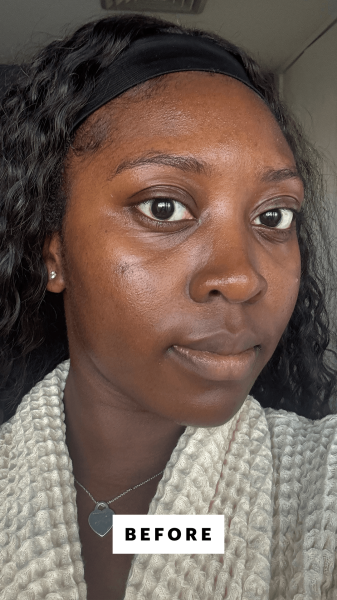
Blay-Tettey before applying the Isdin Fusion Water Magic SPF 40
Annie Blay-Tettey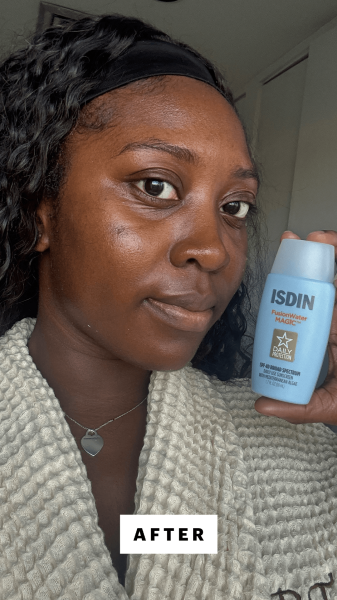
Blay-Tettey after applying the Isdin Fusion Water Magic SPF 40
Annie Blay-Tettey
Tester feedback from associate beauty editor Annie Blay-Tettey
LargeChevron
“This is one of the best sunscreens I've ever used (and I've used many). I love how lightweight yet deeply moisturizing this lotion is. At first, it leaves my skin with a noticeable glow, but as the day goes on, it settles into my skin, not leaving it greasy or shiny. I barely get the sense that I have SPF on my face when I'm wearing it, but I love knowing that I'm covered.” —Annie Blay-Tettey, associate beauty editor
More to know
LargeChevron
- Sunscreen filter: 9% octocrylene, 7.3% homosalate, 4.5% octisalate, 2.7% avobenzone
- Key ingredients: sodium hyaluronate, glycerin, vitamin E, microalgae
- Tinted: no
- Water-resistant: not disclosed
- Fragrance-free: no
Best Over Makeup: Sulwhasoo UV Wise On-the-Go Sun Cushion
 Save to wishlist
Sulwhasoo
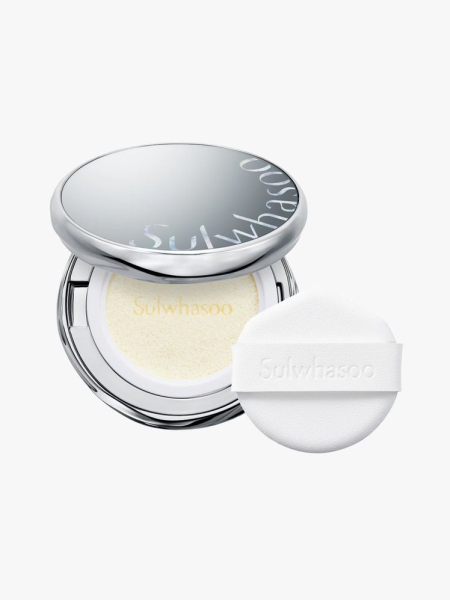
UV Wise On-the-Go Sun Cushion
Sulwhasoo
Allure social director Kassidy Silva applying the Sulwhasoo UV Wise On-the-Go Sun Cushion
Kassidy Silva
Why it's worth it: We all know we should reapply sunscreen every two hours, but putting SPF on over makeup is often easier said than done. “Re-application is the single biggest gap in sun protection behavior, as my patients feel that touching up sunscreen over makeup feels impossible,” says Dr. Yoo. Enter Sulwhasoo UV Wise On-the-Go Sun Cushion SPF 50+, a hybrid formula that pairs chemical filters with titanium dioxide to deliver high-level protection in a makeup-friendly cushion compact. The lightweight formula layers seamlessly both under and over makeup without pilling, smudging, or disturbing foundation, thanks in part to its included applicator, which features tiny “pores” that disperse the formula evenly for a smooth finish.
Beyond SPF, five types of hyaluronic acid and squalane replenish moisture, while antioxidant-rich botanicals like white ginseng and mulberry support the skin barrier and keep skin looking balanced and luminous. “It has a soft, skin-blurring finish that won’t settle into uneven texture or fine lines,” adds Dr. Yoo.
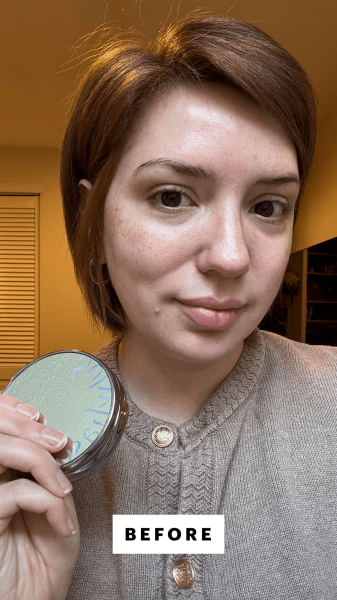
Silva before applying the Sulwhasoo UV Wise On-the-Go Sun Cushion
Kassidy Silva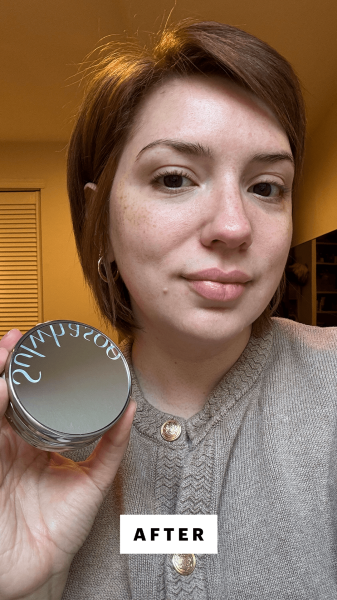
Silva after applying the Sulwhasoo UV Wise On-the-Go Sun Cushion
Kassidy Silva
Tester feedback from social director Kassidy Silva
LargeChevron
“I'd love to be a 'skincare and go' type of person, but I love a full face of makeup. The new Sulwhasoo UV Wise On-the-Go Sun Cushion is gentle on the skin and doesn't pill under makeup, which are two of my top decision-makers on a face sunscreen. Built as a compact, I actually take this in my bag to apply on the go. I've been working on reapplying throughout the day. I can be so lazy, and this is one that keeps me accountable. It does take longer to apply than my other go-to face sunscreens since it's a sponge pad.” —Kassidy Silva, social director
More to know
LargeChevron
- Sunscreen filter: 3% homosalate, 6.5% octinoxate, 3% octisalate, 3.6% titanium Dioxide
- Key ingredients: hyaluronic acid, squalane, white ginseng, mulberry
- Tinted: no
- Water-resistant: not disclosed
- Fragrance-free: no
Frequently Asked Questions
What is a chemical sunscreen?
Chemical sunscreens use chemical UV filters that actually sink into skin, where they absorb ultraviolet radiation and convert it into heat that is then released from the skin, explains Dr. Kil. “Common chemical sunscreen ingredients include avobenzone, oxybenzone, octisalate, octocrylene, and homosalate,” she says. More recently, newer FDA-approved filters such as bemotrizinol (also known as BEMT or Tinosorb S)—which have long been used in Europe and other countries—have begun making their way into the U.S. market, marking “an exciting advancement for sunscreen innovation,” says Whitney Hovenic, MD, a board-certified dermatologist based in Reno, Nevada.
Because these filters are designed to blend into the skin, chemical sunscreens often have a lightweight, elegant finish that makes them especially appealing for everyday use and wear well under makeup.
What's the difference between chemical and mineral sunscreen?
The biggest difference between chemical and mineral sunscreen comes down to how they protect your skin from UV rays. “Chemical sunscreens rely on organic filters that absorb UV rays and dissipate their energy as heat,” says Dr. Kil. Mineral sunscreens, also known as physical sunscreens, use zinc oxide and titanium dioxide to create a protective barrier on the skin's surface; these mineral filters absorb UV radiation and also reflect and scatter a portion of incoming rays.
In general, because they’re absorbed by skin, chemical sunscreens tend to blend more easily and are less likely to leave a visible residue, while mineral sunscreens are often preferred for sensitive skin because they are less likely to irritate. In the US, many chemical sunscreen formulations provide excellent UVB protection, and avobenzone remains the primary filter approved for UVA1 (the long-wave UVA rays that penetrate deepest into the skin and are most closely linked to premature aging and pigmentation) coverage.
Are chemical sunscreens safe?
While studies have shown that chemical sunscreen ingredients can be detected in the bloodstream after repeated application, “there is no evidence of adverse side effects from these filters,” and to date, there is no evidence that approved chemical sunscreen filters cause adverse health effects when used as directed, says Dr. Kil. Dermatologists continue to recommend sunscreen as one of the most effective tools for preventing skin cancer, premature aging, and sun-induced hyperpigmentation. As with any skin-care product, the best broad-spectrum sunscreen is ultimately the one you'll wear consistently every day.
Are chemical sunscreens "bad" for sensitive skin?
Not necessarily, but some people with sensitive skin may find certain chemical sunscreen ingredients irritating. “Chemical sunscreens contain known allergens, such as oxybenzone, a commonly used filter,” says Dr. Kil. In addition, some formulas contain propylene glycol, a humectant that helps sunscreens absorb into the skin but can trigger skin irritation in certain individuals. That said, not all chemical sunscreens are created equal: Many newer formulas are free of common irritants like oxybenzone, fragrance, and propylene glycol, making them better tolerated by sensitive skin. If your skin is especially reactive, patch-testing a new sunscreen before applying it to your entire face is always a good idea.
What is a chemical sunscreen?
Chemical sunscreens use chemical UV filters that actually sink into skin, where they absorb ultraviolet radiation and convert it into heat that is then released from the skin, explains Dr. Kil. “Common chemical sunscreen ingredients include avobenzone, oxybenzone, octisalate, octocrylene, and homosalate,” she says. More recently, newer FDA-approved filters such as bemotrizinol (also known as BEMT or Tinosorb S)—which have long been used in Europe and other countries—have begun making their way into the U.S. market, marking “an exciting advancement for sunscreen innovation,” says Whitney Hovenic, MD, a board-certified dermatologist based in Reno, Nevada.
Because these filters are designed to blend into the skin, chemical sunscreens often have a lightweight, elegant finish that makes them especially appealing for everyday use and wear well under makeup.
What's the difference between chemical and mineral sunscreen?
The biggest difference between chemical and mineral sunscreen comes down to how they protect your skin from UV rays. “Chemical sunscreens rely on organic filters that absorb UV rays and dissipate their energy as heat,” says Dr. Kil. Mineral sunscreens, also known as physical sunscreens, use zinc oxide and titanium dioxide to create a protective barrier on the skin's surface; these mineral filters absorb UV radiation and also reflect and scatter a portion of incoming rays.
In general, because they’re absorbed by skin, chemical sunscreens tend to blend more easily and are less likely to leave a visible residue, while mineral sunscreens are often preferred for sensitive skin because they are less likely to irritate. In the US, many chemical sunscreen formulations provide excellent UVB protection, and avobenzone remains the primary filter approved for UVA1 (the long-wave UVA rays that penetrate deepest into the skin and are most closely linked to premature aging and pigmentation) coverage.
Are chemical sunscreens safe?
While studies have shown that chemical sunscreen ingredients can be detected in the bloodstream after repeated application, “there is no evidence of adverse side effects from these filters,” and to date, there is no evidence that approved chemical sunscreen filters cause adverse health effects when used as directed, says Dr. Kil. Dermatologists continue to recommend sunscreen as one of the most effective tools for preventing skin cancer, premature aging, and sun-induced hyperpigmentation. As with any skin-care product, the best broad-spectrum sunscreen is ultimately the one you'll wear consistently every day.
Are chemical sunscreens "bad" for sensitive skin?
Not necessarily, but some people with sensitive skin may find certain chemical sunscreen ingredients irritating. “Chemical sunscreens contain known allergens, such as oxybenzone, a commonly used filter,” says Dr. Kil. In addition, some formulas contain propylene glycol, a humectant that helps sunscreens absorb into the skin but can trigger skin irritation in certain individuals. That said, not all chemical sunscreens are created equal: Many newer formulas are free of common irritants like oxybenzone, fragrance, and propylene glycol, making them better tolerated by sensitive skin. If your skin is especially reactive, patch-testing a new sunscreen before applying it to your entire face is always a good idea.
Meet the experts
- Asmi Berry, DO, is a board-certified medical and cosmetic dermatologist at BHSkin Dermatology Practice based in Glendale, California
- Whitney Hovenic, MD, a board-certified dermatologist and co-founder of Spooge based in Reno, Nevada
- Erin Kil, MD, a board-certified dermatologist of New Bloom Dermatology and clinical assistant professor at Mount Sinai Health System based in New York City
- Pearl Rimtepathip, MD, a board-certified dermatologist at MetroDerm based in Atlanta
- Geeta Yadav, MD, a board-certified dermatologist based in Toronto, Canada
- Jane Yoo, MD, a dual board-certified dermatologist and Mohs surgeon based in New York City
How we test and review products
When Allure tests a product, our editors look at it from every angle in an effort to best serve you. We review ingredients, scrutinize brand claims, and, when necessary, examine peer-reviewed scientific and medical studies. In addition to testing each and every product that's included in each and every review, we rely on experts who shape their fields, including dermatology, cosmetic chemistry, and medicine, to help us vet the ingredients and formulas.
For our list of the best chemical sunscreens, we considered each product's performance across five primary categories: product ingredients and efficacy, packaging, fragrance, texture, and product wear. Every product was determined to have excelled in each category by our editorial team, which is composed of in-house writers and editors as well as contributors—along with special consideration from dermatologists. To learn more information on our reporting and testing processes, read our complete reviews process and methodology page.
Our staff and testers
A beauty product is a personal purchase. You might be searching for a face cream to address persistent dryness or a new nail product to add to your Sunday self-care routine; you may simply be browsing around for the latest launches to hit the hair market. No matter what you seek or your individual needs and concerns, Allure wants to ensure that you love anything we recommend in our stories. We believe that having a diverse team of writers and editors—in addition to the wide range of outside testers and industry experts we regularly call upon—is essential to reaching that goal.
After all, can we really say a skin-care product is the "best" for people over 50 if the only testers we've solicited opinions from folks who have yet to hit 30? Can we honestly deem a high-end diffuser worthy of your hard-earned cash if it's never been tested on curls? We're proud that our staff spans a wide range of ages, skin tones, hair textures, genders, and backgrounds, which means that we are able to fairly assess any beauty product that comes into the beauty closet.